Tag: communication

  • 8Tagg – a blogospheric answer to fb…

    … and a lot easier than running around the school yard!

    So there’s this meme floating around the blogosphere – let’s call it 8Tagg, seeing as how it requires you to reveal 8 things about yourself that people don’t know.

    First you list aforementioned 8 things.

    Then you “tagg” a string of your blog-buddies. (This is apparently done by hotlinks, pingbacks and somesuch. I’m placing my hope on Technorati to inform those I tag, seeing as how Blogger doesn’t support pingbacks – as far as I know.)

    Tagging someone makes them “It” (fond memories right there…), which means they now have to do the same.

    So, in the spirit of Twain’s first meme, here goes:

    1. I never ended an educational phase (pre-primary, primary, secondary, tertiary) in the same school I started it. With my Dad being one of the few Land Surveyors in SA, we moved around a lot. I guess it became a habit.

    2. I’m a Geminian Earth Horse (Gemini sun and rising, Sagittarius moon, year of the Horse etc). This apparently also explains my bouts of wanderlust.

    3. I love writing, but I suck at correspondence. (Okay, maybe you knew that *lol*)

    4. I have an immense urge to snap my fingers over the flame when people light their cigarettes with a candle. (Somewhere deep inside, my inner child still believes that fairies die if you don’t.)

    5. I joined AA at the beginning of 2008. (Not very anonymous of me, is it?)

    6. I’m addicted to puff pastry – especially if it’s baked around a Russian. (But I try to avoid all starch in my diet.)

    7. Quitting smoking was harder than quitting alcohol or starch. (1 month and 20 puff-free days now!)

    8. I fall in love with faces. (Flickr breaks my heart every week ;0) hehe.)

    Now, who’ll be “It” then? checkitout:

    Geoff – my best blog-buddy, all the way from Idaho,

    Jayx – one of the zaniest characters to’ve lit up my life since my move to the Garden Route,

    Tresblue – he who got me blogging for real,

    Jockohomo – I’m a fan! A giant of the online world and my daily dose of provocation/inspiration,

    Warrior Scout – he who’s kickin tina and inspiring me along the way.

    I’ve tried not to tagg people who’ve already been 8Tagged. If I inadvertently did so, please accept my sincere apologies.

    (Please advise if I’m somehow not adhering to proper online conduct in tagging you, or transgressing in any other way for that matter.)

  • load shedding schedule for George and Danabaai

    We just phoned our local municipalities for the latest load shedding schedules:

    George:
    Daily from 10:00 – 12:30 and 18:00 – 20:30

    Danabaai:
    Monday, Wednesday, Friday: 14:00 – 16:30 and 22:00 – 00:30
    Tuesday, Thursday, Saturday: 04:00 – 06:30, 14:00 – 16:30 and 22:00 – 00:30
    Sundays: Random

    Right, what does this mean for my business? In a nutshell: over half of my clients will have to place their orders between 08:00 and 10:00 or 12:30 and 14:00 – as I can only process these between 08:00 and 14:00. (That’s a 3-hour window for George clients!)

    Georgians also have a tiny one-hour window (17:00 – 18:00) in which to do all their private shopping, refueling, cooking and cleaning. Unless they wait till 20:30 – when most shops are closed.

    Living in Danabaai is a lot easier. Work till 14:00 and (from 16:30) only worry about electricity again at 22:00.

    Memo to self: Get a wind-up alarm clock and save the planet, as well as your working week! (Electrical ones reset close to three times a day, you know…)

  • Power in SA – a lucky draw

    Welcome to the latest update on our power situation. Several “schedules” for load shedding in our region have been published – none of them showing the same times…

    In an attempt to plan my days, I turned to the Eskom website for answers. Turns out there’s no fixed schedule – whatever happens, depends on whatever happens.

    [Your town is] subject to the scenarios listed at the times specified for load shedding. If any of the stages are reached today, these schedules will apply.

    Brown Stage 3B
    12:00 – 14:30

    Brown Stage 3B
    20:00 – 22:30

    Brown Stage 1A
    18:00 – 20:30

    Brown Stage 1B
    12:00 – 14:30

    Brown Stage 2A
    12:00 – 14:30

    Brown Stage 2A
    18:00 – 20:30

    Brown Stage 2B
    12:00 – 14:30

    Brown Stage 2B
    20:00 – 22:30

    Brown Stage 3A
    12:00 – 14:30

    Brown Stage 3A
    18:00 – 20:30

    In short: Cross your fingers – you might be f*(%3d today, or not.

  • Mark Twain on Memetics

    Not sure how memes work?
    This Wikipedia entry might help as well:

    A Literary Nightmare” is a short story written by Mark Twain in 1876. The story is about Twain’s encounter with a virus-like jingle, and how it occupies his mind for several days until he manages to “infect” another person, thus removing the jingle from his mind. The story was also later published under the name “Punch, Brothers, Punch!”

    The story is significant in that it is a fairly accurate description of a meme, and how it can replicate itself in a short time, thus acting like a virus in some respects.

    (In a nutshell, the story goes a little something like this)

    The narrator, Mark Twain, sees a catchy jingle in the morning newspaper. The jingle promptly attaches itself to his mind, such that he loses concentration and can no longer remember what he ate for breakfast, whether he ate at all, and what words he was going to use in his novel. The jingle mentally incapacitates him, until, a few days later, he takes a walk with his friend, the Reverend, and inadvertently transfers the jingle to the reverend’s mind. As this happens, Twain experiences a sense of relief, and returns to his normal life.

    Some days after Twain was cured, the Reverend visits him; he is in a terrible state, as the jingle, which keeps on repeating in his head, has already disabled his concentration. He tells Twain of some incidents where the rhythm of the jingle influenced his actions, such as when churchgoers started swaying to the rhythm of his homilies. Taking pity on the man, Twain decides to cure him, and brings him to a meeting of university students. The Reverend successfully manages to transfer the jingle from himself to the students, curing himself and, at the same time, continuing the diabolical cycle of the jingle.

  • awesome feature from iafrica.com

    Different worlds? Maybe not…
    Jerome Simelane [Thu, 03 Jan 2008]

    I am a guy and he is a guy. We are from different worlds. Ja well, no fine — what the hell do I mean? Well, here’s the question: To all straight people, how many people do you know that are gay and your friends?

    I am the first to confess that I never thought about it. Now, having watched a few episodes of ‘Will & Grace’ I feel I’m qualified to talk on this subject simply because I can laugh myself stukkend while watching the show.

    It is a great programme, with sarcasm and satire that most open-minded people can relate to. It is both liberated and liberating.

    I never thought I would watch a ‘gay’ sitcom and catch myself laughing and that got me thinking that the whole issue about straight people not relating to gay people is overstated.

    In reality…

    One of my life-long friends just recently came ‘out’ to me. What I find disturbing is that his revelation made me uneasy at first. Okay, maybe not uneasy but I was shocked and flabbergasted.

    This oke, with whom I was so close, was gay and had been all along. It took me some time to process but I realised that it was not up to me to be judgmental — rather, I should be supportive.

    Fully aware of the stigma of being gay, lesbian, queer, moffie, or whatever (who knows what homosexuals are called these days) made me think that my friend (and I still refer to him as my bra) was going through identity hell. He didn’t need me to let his revelation get in the way of our friendship.

    Which brings me to the next question: “What is so strange about someone being gay?”

    Being heterosexual, I don’t expect others to say: “Hey, mfowethu, look, I’m straight!” Duh! That is no revelation to me, it’s like second nature. Which proves we tend to judge others, make assumptions and reach conclusions based on our own beliefs and way of navigating the world — and that subjectivity is so wrong.

    What’s the difference?

    Back to my friend: We hang together, talk about politics, cars, sex, blah, blah, blah. In actual fact, there is, or rather there was, no difference that was ‘out there’ for me to evaluate.

    Believe me, he is not a sissy or trying to be what he ain’t. Now I know that whenever we talked about J Lo’s behind, he was busy picturing Denzel Washington’s eyes or Brad Pitt’s torso and probably devouring Vin Diesel.

    But he’s still a guy’s guy to me — we haven’t stopped hanging out, drinking beer, chatting… (although I have to admit its hard to concur whenever he says, “That guy is cute”).

    So I guess if I’m going to be a friend I would have to hook him up with a decent, good-looking, to-die-for guy. I have no flippin’ clue where I might find such a person, but I am making an effort. And, whoever said that “plenty of fish in the sea” thing was lying. Sometimes there aren’t.

    True friends

    The saying, “you cannot choose family” should actually also extend to friends. We hit it off from the beginning and we have grown to know each other very well. A true friend would not desert another friend based solely on the fact that you are now attracted to a different gender.

    That he was secure enough to come out is an indication that he trusts me and I admire and have a lot of respect for my bra. Not a lot of people can do that.

    And even though this piece is entitled, ‘Different World’, how different are we, really, as people? So if you’re a guy and struggling to relate to a gay friend, here’s some advice — get some microwave popcorn and watch ‘Will & Grace’.

    I am a guy and he is a guy. Full stop.

    iafrica.com | highlife | his life | features Different worlds? Maybe not…

  • Apparently, some (str8?) men need (more) help

    The page cannot be displayed because you need to approach some women

    The page you are looking for is currently unavailable. Your Mom told me you’ve been online for way too long and you
    need to go out and approach some women.


    Please, try the following:


    • Don’t click the Refresh button. Go outside now.
    • To go outside, first click Put On Shoes. On the Wussy tab, clic Time to Make a Girl’s Day. The Ass is Plastered to My Chair setting should match those provided by your pickup coach.
    • If you are addicted to information, try to cut down a bit.
    • Click the Make a Commitment button and approach one woman every day. It gets easier with every approach.
    • If you would like to be happier than you’ve ever been before in your entire life, click
      Go Out Into the Real World
    • There are many hot women out there in the real world who are tired of wussies who won’t come up to them and talk to them. If you are unable to get up, click back and pay for a coach to kick your ass.

    HTTP Error 404 – File or Directory not found.

    Internet Information
    Overload (IIO)


    Technical Information (for a better life)

    • Go to ApproachAnxiety.com and perform a title search for the words Fear, Overcome and Exhilaration.
    • Open Coaching Help, which is accessible in the Coaching Section, and search for topics titled Push Me into Approaches, Show Me How to Do It, and Understand My Irrational Fear.

    Blogged with Flock

  • The Knoetze Bloodline


    If anyone wondered where I’d gone to – or why I’ve been relatively quiet lately – check this out! I’ve been researching and building my family tree – and am at a place where I can show the world!!

    *Muwahahahahahaaa*

    Click through to http://theknoetzebloodline.myheritage.com and have a peek. If you happen to fit in there somewhere – drop me a line and I’ll register you as an administrator!!

    All my love,
    Willie

  • MadV – inspire

    I’ve missed the Nov 5 deadline for the Remember project . Wasn’t all too happy with myself – but then I realized that 5 Nov wasn’t a deadline – it was the birth of a project.

    After seeing MadV’s latest video – I’m amped as ever to get it together!

    [youtube https://www.youtube.com/watch?v=ZkQSi3iJwlY&rel=1&w=425&h=355]

  • How to Learn (But Not Master) Any Language in 1 Hour…

    Click through to the original article on the “4 Hour Work Week” blog and end up discovering a whole new world of ideas :0)

    For those not prone to that level of exploration – here’s a glimpse:

    arabic-script.jpg
    Deconstructing Arabic in 45 Minutes

    deconstructing-russian.jpg
    Conversational Russian in 60 minutes?

    This post is by request. How long does it take to learn Chinese or Japanese vs. Spanish or Irish Gaelic? I would argue less than an hour.

    Here’s the reasoning…

    Before you invest (or waste) hundreds and thousands of hours on a language, you should deconstruct it. During my thesis research at Princeton, which focused on neuroscience and unorthodox acquisition of Japanese by native English speakers, as well as when redesigning curricula for Berlitz, this neglected deconstruction step surfaced as one of the distinguishing habits of the fastest language learners.

    So far, I’ve deconstructed Japanese, Mandarin Chinese, Spanish, Italian, Brazilian Portuguese, German, Norwegian, Irish Gaelic, Korean, and perhaps a dozen others. I’m far from perfect in these languages, and I’m terrible at some, but I can converse in quite a few with no problems whatsoever—just ask the MIT students who came up to me last night and spoke in multiple languages.

    How is it possible to become conversationally fluent in one of these languages in 2-12 months? It starts with deconstructing them, choosing wisely, and abandoning all but a few of them.

    Consider a new language like a new sport.

    There are certain physical prerequisites (height is an advantage in basketball), rules (a runner must touch the bases in baseball), and so on that determine if you can become proficient at all, and—if so—how long it will take.

    Languages are no different. What are your tools, and how do they fit with the rules of your target?

    If you’re a native Japanese speaker, respectively handicapped with a bit more than 20 phonemes in your language, some languages will seem near impossible. Picking a compatible language with similar sounds and word construction (like Spanish) instead of one with a buffet of new sounds you cannot distinguish (like Chinese) could make the difference between having meaningful conversations in 3 months instead of 3 years.

    Let’s look at few of the methods I recently used to deconstructed Russian and Arabic to determine if I could reach fluency within a 3-month target time period. Both were done in an hour or less of conversation with native speakers sitting next to me on airplanes.

    Six Lines of Gold

    Here are a few questions that I apply from the outset. The simple versions come afterwards:

    1. Are there new grammatical structures that will postpone fluency? (look at SOV vs. SVO, as well as noun cases)

    2. Are there new sounds that will double or quadruple time to fluency? (especially vowels)

    3. How similar is it to languages I already understand? What will help and what will interfere? (Will acquisition erase a previous language? Can I borrow structures without fatal interference like Portuguese after Spanish?)

    4. All of which answer: How difficult will it be, and how long would it take to become functionally fluent?

    It doesn’t take much to answer these questions. All you need are a few sentences translated from English into your target language.

    Some of my favorites, with reasons, are below:

    The apple is red.
    It is John’s apple.
    I give John the apple.
    We give him the apple.
    He gives it to John.
    She gives it to him.

    These six sentences alone expose much of the language, and quite a few potential deal killers.

    First, they help me to see if and how verbs are conjugated based on speaker (both according to gender and number). I’m also able to immediately identify an uber-pain in some languages: placement of indirect objects (John), direct objects (the apple), and their respective pronouns (him, it). I would follow these sentences with a few negations (“I don’t give…”) and different tenses to see if these are expressed as separate words (“bu” in Chinese as negation, for example) or verb changes (“-nai” or “-masen” in Japanese), the latter making a language much harder to crack.

    Second, I’m looking at the fundamental sentence structure: is it subject-verb-object (SOV) like English and Chinese (“I eat the apple”), is it subject-object-verb (SOV) like Japanese (“I the apple eat”), or something else? If you’re a native English speaker, SOV will be harder than the familiar SVO, but once you pick one up (Korean grammar is almost identical to Japanese, and German has a lot of verb-at-the-end construction), your brain will be formatted for new SOV languages.

    Third, the first three sentences expose if the language has much-dreaded noun cases. What are noun cases? In German, for example, “the” isn’t so simple. It might be der, das, die, dem, den and more depending on whether “the apple” is an object, indirect object, possessed by someone else, etc. Headaches galore. Russian is even worse. This is one of the reasons I continue to put it off.

    All the above from just 6-10 sentences! Here are two more:

    I must give it to him.
    I want to give it to her.

    These two are to see if auxiliary verbs exist, or if the end of the each verb changes. A good short-cut to independent learner status, when you no longer need a teacher to improve, is to learn conjugations for “helping” verbs like “to want,” “to need,” “to have to,” “should,” etc. In Spanish and many others, this allows you to express yourself with “I need/want/must/should” + the infinite of any verb. Learning the variations of a half dozen verbs gives you access to all verbs. This doesn’t help when someone else is speaking, but it does help get the training wheels off self-expression as quickly as possible.

    If these auxiliaries are expressed as changes in the verb (often the case with Japanese) instead of separate words (Chinese, for example), you are in for a rough time in the beginning.

    Sounds and Scripts

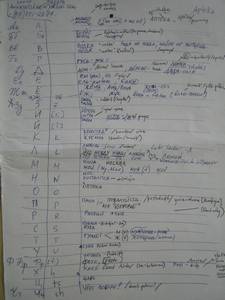
    I ask my impromptu teacher to write down the translations twice: once in the proper native writing system (also called “script” or “orthography”), and again in English phonetics, or I’ll write down approximations or use IPA.

    If possible, I will have them take me through their alphabet, giving me one example word for each consonant and vowel. Look hard for difficult vowels, which will take, in my experience, at least 10 times longer to master than any unfamiliar consonant or combination thereof (”tsu” in Japanese poses few problems, for example). Think Portuguese is just slower Spanish with a few different words? Think again. Spend an hour practicing the “open” vowels of Brazilian Portuguese. I recommend you get some ice for your mouth and throat first.
    russian-alphabet.jpg
    The Russian Phonetic Menu, and…

    reading-real-russian.jpg
    Reading Real Cyrillic 20 Minutes Later

    Going through the characters of a language’s writing system is really only practical for languages that have at least one phonetic writing system of 50 or fewer sounds—Spanish, Russian, and Japanese would all be fine. Chinese fails since tones multiply variations of otherwise simple sounds, and it also fails miserably on phonetic systems. If you go after Mandarin, choose the somewhat uncommon GR over pinyin romanization if at all possible. It’s harder to learn at first, but I’ve never met a pinyin learner with tones even half as accurate as a decent GR user. Long story short, this is because tones are indicated by spelling in GR, not by diacritical marks above the syllables.

    In all cases, treat language as sport.

    Learn the rules first, determine if it’s worth the investment of time (will you, at best, become mediocre?), then focus on the training. Picking your target is often more important than your method.

    [To be continued?]

    Blogged with Flock

  • Gay words on Faith

    http://youtube.com/v/COZxeiWaMn8

    I found this little clip by accident. Americans have a “National Coming Out Day” (October 11), and this post was part of 2007’s “Video Quilt”.

    Check it out.